Hands-on Healing: Students Rally to Protect Noggin’s Noggin
November 10, 2025 | Payton Potter | Student Success
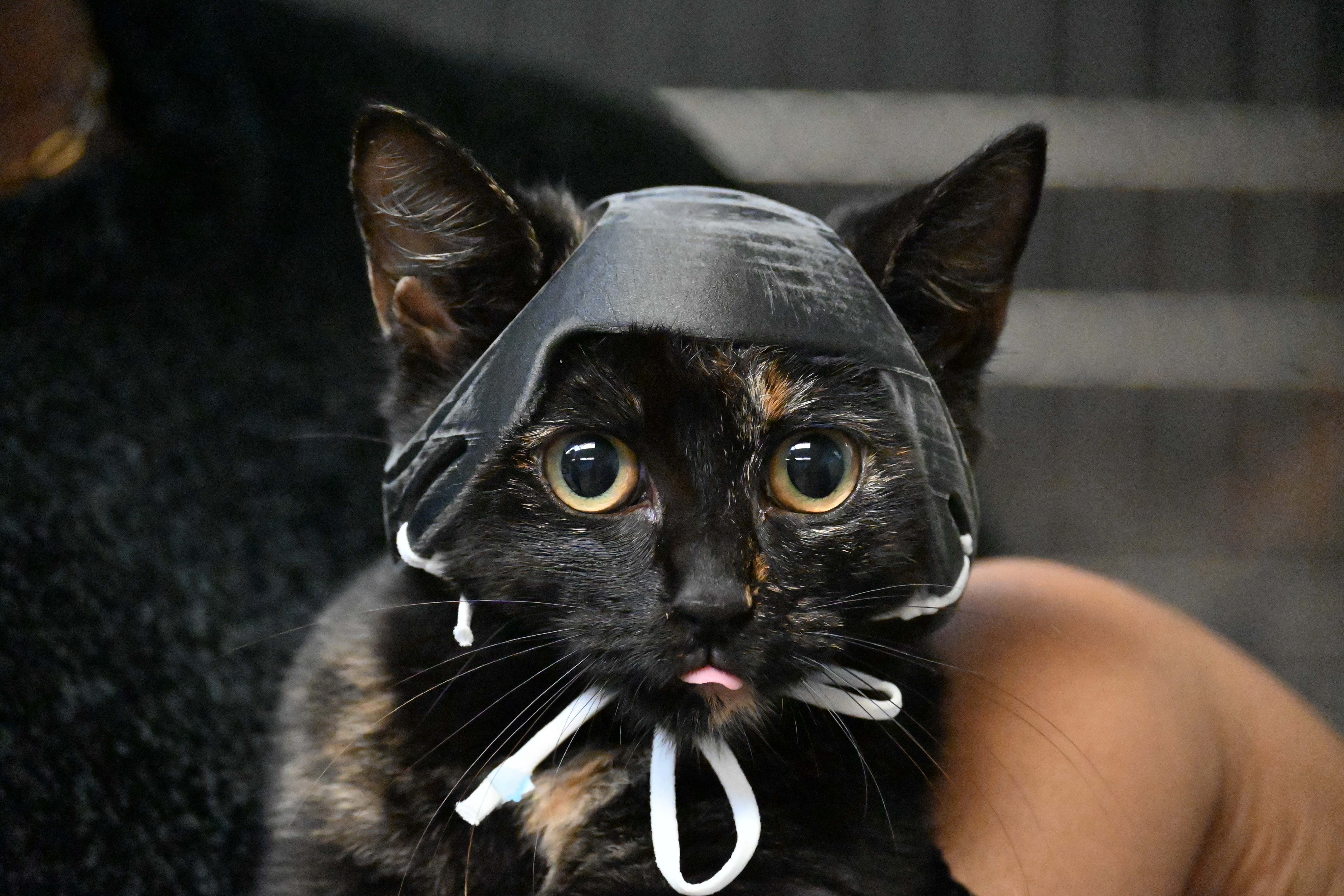
Noggin isn’t a superhero—she just looks like one.
Walking through McKamey, one is overwhelmed by the barks and meows of animals awaiting adoption. But in one corner of Dr. Adam Winn’s clinic, a kitten named Noggin sits quietly, wearing a black plastic helmet.
Noggin’s story began in early October, when she was found wandering in a parking lot in Chattanooga. A bystander captured the 3-month-old kitten and took her to McKamey Animal Center, where Dr. Winn appraised her and found that she had a skull fracture, a brain injury, and vision loss.
The custom-designed helmet Noggin now wears protects her fractured skull while she undergoes the two-step healing process, starting with her brain. Dr. Winn said Noggin’s fracture is, ultimately, good news for a kitten with a brain injury.
In most cases, surgery is required to prevent further injury to the brain, but the fracture allows her brain to swell without encountering pressure against her skull. Still, the vulnerable skull must be protected.
That’s where TCAT at ChattState comes in.
One day at the clinic, ChattState Veterinary Technology students were doing hands-on learning under the guidance of instructor Ann Cho when they overheard Dr. Winn and his team discussing the need for a rigid helmet to protect Noggin’s noggin.
Cho reported back to Machine Tool Technology instructor Sam O’Rear, who decided the opportunity to design and create a 3D-printed helmet to protect the kitten’s head would allow his students a hands-on opportunity to see how their classroom work can apply to the real world.
O’Rear and his student, James “Tuggy,” quickly accepted the challenge and went to work altering an existing design to fit Noggin’s head measurements. Tuggy repositioned the ear openings, resized the helmet’s contours, and refined it to fit Noggin comfortably.
“I’ve printed a lot of things before, but never something that needed to fit an animal,” Tuggy said. “It was a new challenge, learning how to match what I designed to something as small and unique as Noggin's head.”
The project combined several core elements of TCAT at ChattState’s Machine Tool Technology program, including AutoCAD design, precision measurement, and materials engineering. The result? A helmet reinforced with fiberglass designed to protect Noggin’s skull fracture while still providing flexibility to accommodate the playful kitten.
“When you take on something like this, you’re not just designing and printing,” O’Rear explained. “You’re working with a customer—in this case, the veterinary surgeon—to meet very specific needs. It’s the same kind of collaboration you’d find in an engineering or manufacturing environment.”
The first helmet prototype included a small plastic band (similar to how a football player’s helmet protects his face) to stop Noggin from running into things. Dr. Winn quickly learned Noggin’s other senses had compensated for her limited vision and asked Tuggy to pivot to a simpler design.
“She can’t see, but she can smell and hear just fine. The helmet gives her the protection she needs while she learns to navigate safely,” Dr. Winn said. “She’s an amazing cat.”